The fight goes on.
July 29, 2018

February 17, 2018
Celeste Is a Very Interesting Failure

After the game frenzy of 2017, I'm glad to report that, a month and a half into the new year, the rate of new, interesting games coming out has been considerably lower than in the parallel time period of last year. I can't blame anyone for wanting to stagger their game's release now: I wouldn't want to follow the year of Night In the Woods, Mario Odyssey and The New Colossus, either. And yet, three brave titles have stepped up to attempt to grab the gaming public's attention at this early time of January-February: Iconoclasts, Celeste and Dandara.
I've yet to play Iconoclasts, although I fully intend to, and I've only just started Dandara. But I've already put a considerable amount of time into Celeste and it's... not very good, is it?
This is the point where I usually give the obligatory spiel about how I didn't dislike Celeste because of its difficulty, but this seems unnecessary this time, because, for a change, the Good Gamer brigade did not come out to defend this game from any possible criticism. My assumption is that they tried to reconcile the need to attack any game with a female protagonist with the need to defend any game proclaimed difficult and their little heads exploded from the contradiction du machisme.
Having said that, I... actually don't think the game is that hard? It's certainly not easy, but I don't see this stumping any seasoned platformer veteran. Much like with last year's Cuphead, it's one of those games that provide a healthy, well-balanced challenged, although I... really don't think there's any point in rising up to it.

My biggest problem with Celeste is that I just don't buy it. I don't mean the game itself I did buy that, and on the Nintendo eShop too, so it was pretty expensive. But I don't buy the setup of this game. With other games that sell themselves on extreme difficulty or on trial-and-error, the punishment and the grind always fits in with the world the games inhabit. Super Meat Boy was cute, but you were playing a constantly-bleeding meat-person who was fighting an evil fetus. Hotline Miami is all about nasty, casual brutality, in both setting and gameplay.
But I just don't buy these cute characters, taken straight from a Scandinavian children's cartoon, as actors in a world full of evil, death and precision platforming. I don't. And although the tone of the game does get progressively darker, it's still, at least until the point where I fell off - around the end of chapter 5 - a wild, wild contrast that is never properly bridged.
And even though the game never sat right with me on this level, I decided to just go with it, hoping I didn't just pay eShop prices for a game that I really didn't find all that remarkable. But what really pushed me off, what really drove me up the wall, is when the game needlessly locks you out of previous areas.
To explain why this is so annoying, I have to explain some things about collectibles in Celeste. Celeste has, as far as I could tell, four types of collectibles: red hearts, blue hearts, cassettes ("b-sides") and - the most common - strawberries. I won't get into the first three, but strawberries are basically collectibles that you get by going off the beaten path and completing challenges more demanding that those you need to just get through a level.

It's an attempt to give what appears to be a pretty short game more longevity, but I find that often, this sort of thing does the exact opposite. I'd argue that carefully labeling the exact extra things a player can do puts one into a frame of mind where, once you get all of the collectibles, you've gotten everything you can out of the game. I can think of very few games with collectibles that I didn't stop playing altogether once I got all the collectibles. It's almost a guarantee that I will only play a game once.
But even putting that aside, Celeste has this infuriating habit of locking you out of areas without so much as a warning, meaning that every time you go past what the game has decided is a cut-off point, if you realize you missed some strawberries in the last section, you actually have to go back to the level select screen and start the whole section again just to get one strawberry the game indicates you missed near the end.
And this doesn't always even happen by choice. What finally led me to be done with this game is when an enemy explosion sent me to the next room prematurely, with a strawberry still in plain sight in the room before, and with no option of going back. And yes, the game does tell you that you don't have to pick every single strawberry up. But the truth of is, much of the challenge and the fun I've had with the game was when I was trying to pick up strawberries. Just getting through the game's main path felt, to be frank, a bit dull.
And that's a shame, because the plot bits up to that point really started to hint at much more interesting things coming up. Celeste is not the name of the game's protagonist, who's named Madeline, but of the mountain that she is climbing. At first it seems like just a random game premise, but very soon it becomes clear that the mountain climb is an analogy to Madeline's need for a challenge, to prove something to herself, to overcome her own inner demons.

Along the way there are also some interesting characters - an old woman who speaks in ominous tones, the ghost of an abandoned hotel's owner, and most importantly, Theo, a professional photographer who came to the mountain in search of the ultimate photo opportunity. Theo's dialogue is pretty cringe-worthy at times, and I hate it in general when media tries to be super-hip with lame social media references - Theo keeps mentioning his "InstaPix" account, and often speaks in hashtags - and in niche video games, one should really know better. But as a character, Theo is mostly charming, likable, and provides some much needed emotional respite from the intensity of some of the rest of the mountain's inhabitants.
He's also black, which is probably another reason why the Good Gamers are nowhere to be seen.
When Celeste is good, it's pretty good. It's cute, visually pleasing, and the satisfaction from figuring out how to get to a seemingly impossible to reach strawberry is certainly there. It's just a shame that the game chose to be so obtuse and so inconceivably badly designed at points that the best compliment I could give it is that I found it very interesting to try and analyze just how wrong it all went.
Well, that's enough of that.

January 23, 2018
The Psycho Mantis Video Game Awards 2017
Oh hey there! I never mentioned I have a YouTube channel now, did I? I should probably uh, put my videos up here as well. Oh well! Here's my yearly roundup of the best and worst of the games of last year, and feel free to browse the rest of the channel as well while you're at it, why doncha. See you around!
October 11, 2017
Cuphead Isn't the Dark Souls of Anything Because Dark Souls Isn't Fucking Boring

Sometimes I wonder if my efforts to stay on top of new video game releases are time well spent on my part. Not only do I work a full time job, while trying to maintain a decent output of music, game analysis videos and occasional writing, but I also own so many video games already that I would love to play again. Hell, just last month I played Final Fantasy VII for the bazillionth time to prepare for my 20-year video retrospective of it, and I had the time of my life.
On the other hand, we live in a fantastic time for games. Almost every year adds a new video game to the list of my all-time favorites. Downwell, Undertale, DOOM, Yakuza 0, just to give a few examples, are games I absolutely adore, and I would never have heard of most of them if I didn't follow game releases closely and forced myself to play most of the ones that seem interesting.
I write about games because I love thinking about them about as much, if not more, than I love playing them. This year has been especially good for that. Take Night In the Woods, Hollow Knight, and the recently released Cuphead. These games have something in common, other than each having a gorgeous, unique visual style. Each one also inspired a very specific thought in me as I played them.

Night In the Woods made me think about alienation, about the impossibility of being comfortable where you grew up once you move away, about how we can maintain our relationships with family and childhood friends as we mature - and how sometimes, we just shouldn't.
Hollow Knight made me think about the nature of struggle, about the ways in which we can deal with ruin, with failure, with overwhelming odds. (And also about how I hate that little delay between moving and jumping, for fuck's sake.)
Cuphead put a far simpler, for less pretentious thought in my head. Cuphead simply constantly had me thinking: why am I doing this?
And I do mean that literally. Why was I playing this game?
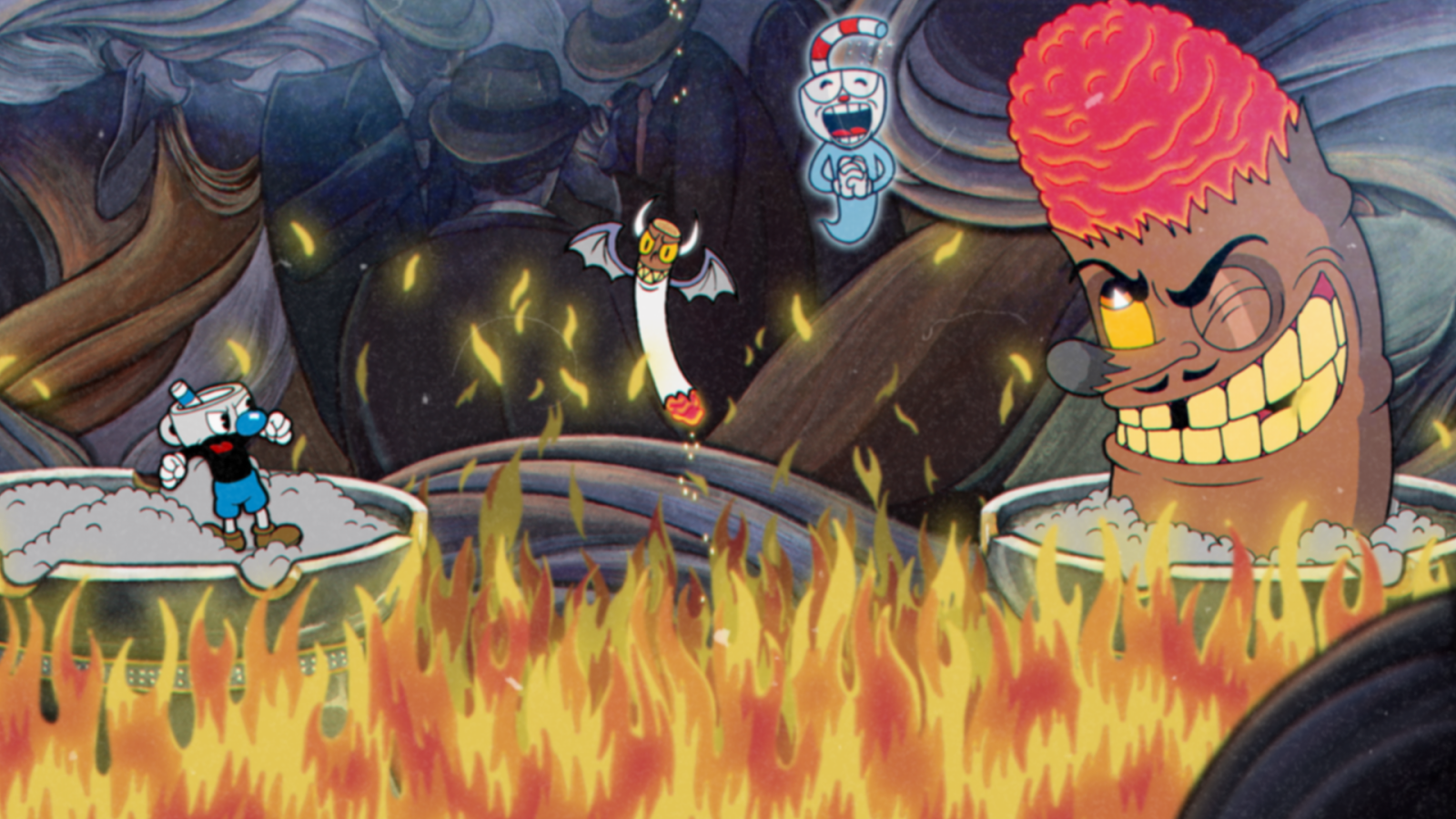
Now, I realize Cuphead is the latest instrument for a certain sad group of losers to mock and belittle others in the service of building up their own fragile male ego, and so, obviously any criticism of Cuphead - no matter its content - will be dismissed as being made on the basis of not being good at the game. I will, however, say for the record that I did not find Cuphead needlessly difficult. Mind you, I'm not saying it's easy - I think it provides a well-balanced and healthy challenge for people who like hectic action games.
Difficulty isn't why I disliked Cuphead. I disliked it because it's just SO. DAMN. BORING. It's also why I haven't touched it after finishing the first island, and never will. In fact, all the images in this post are from the game's press kit, because I cannot stand to devote a single minute more to the game than I already have by playing it and writing this post.
Once you ignore Cuphead's frankly stupid plot, its premise is quite simple: you access levels from a world map, each one either a platforming level where you fight a set of normal enemies, or a boss level, which consists solely of the boss itself. If there are more types of levels, I do not know, nor do I care to.

Platforming levels are simple affairs, and you can probably get through them without too much difficulty. The real challenge of these levels is to collect coins, which are sometimes hard to reach, and which are required to buy upgrades in the overworld store.
Collecting the harder-to-reach coins often relies on a game mechanic called "parrying", which is really nothing of the kind. Parrying, a-la Cuphead, is when you press a button when your character is about to collide, mid-jump, with a pink object - any pink object will do - at which point your character will perform a mid-air jump. Why this maneuver exists, I cannot tell you. It probably helps to build up your special attack meter - I can't remember and will not bother to check - but it's a trivial move to carry out in the platforming levels, and in the boss levels, where it's usually more challenging, just seems unnecessary. Why would I risk getting hit for such a minor advantage? It makes more sense to avoid the shot and keep firing at the boss. I can hardly understand the inclusion of this mechanic, and I struggle to justify its name except as an excuse to invite comparisons to Dark Souls - as if the internet needs those.
If we've already gotten into it, the bosses are where it's at in Cuphead, to the extent that anything is there at all. But something about the boss fights is just... off. They start and end with such little fanfare that there's no feeling of dread when a fight starts, nor is there a feeling of achievement when they fall. They feel as paper-thin as the material they were masterfully drawn on.
Cuphead's poor audio-visual feedback in general makes everything lack impact. Shooting in the game makes really a lame sound, meant to be zany, for sure, but which serves as a poor method of making the game feel fun. It also feels unnecessary because, for the most part, shooting is just holding down a button. It rarely requires any skill, any aiming whatsoever, so I found myself mostly just keeping the button pressed and concentrating more on dodging incoming attacks. How do you make a run and gun game where using your gun feels so... meh?

And how, indeed, do you make a game that looks like Cuphead so boring? Because, I have to stress, the art style in the game is amazing, truly beautiful to behold. But Cuphead is a stark reminder that visuals alone are not enough. Games need to feel tactile. Mechanics need to feel like they have weight. Combat needs to feel like something is at stake. And none of this is anywhere to be found in Cuphead.
So, for all the drama opportunist shitlords have already created, Cuphead is really not worth all the attention. It's a mediocre affair with really good graphics. And if you want those, just watch a cartoon. For my part, I'm not going to score Cuphead, even though this is practically a review, because to justify a score I would need to spend more time with it, which I simply have no intention of ever doing.
It's just not worth the effort.

August 6, 2017
Tacoma Review
AI Justice Warrior
Here's a story you've heard a thousand times before: it is the future. A very powerful corporation is obviously evil, but presents itself as a force for good. Things aren't what they seem, and there is a conspiracy to hide this fact. Also, is AI the same as human consciousness? Is it dangerous? Should it have the same rights as us?
Tacoma is full of such overused sci-fi cliches, and in lesser hands, it would be just another throwaway story about the evils of technology. But thanks to clever storytelling, informed by social consciousness and masterful character development, Tacoma manages to rise above the tropes and actually say new and interesting things about its well-treaded subject matter. The result is an exceptionally effective and touching plot-driven game - one whose more cringe-inducing moments are easy to forgive.
Developer: Fullbright
Publisher: Fullbright
Release Date: August 2, 2017
MSRP: 19.99$
Rig: Intel i5-4440 @ 3.10GHz
16GB RAM
Zotac GeForce GTX 980 Ti AMP! Extreme
Publisher: Fullbright
Release Date: August 2, 2017
MSRP: 19.99$
Rig: Intel i5-4440 @ 3.10GHz
16GB RAM
Zotac GeForce GTX 980 Ti AMP! Extreme
Tacoma is the second release by developer Fullbright, a studio known for the critically acclaimed 2013 game Gone Home, a game that. despite my best intentions, I simply could not stand. I thought its writing was amateur and that attention to detail was distributed in the worst way possible. It was a game where you could pick up every pen and kitchen utensil, but you couldn't have a single meaningful interaction with the world the developers built.
You can still pick up a lot of random stuff in Tacoma, but this time around, we are allowed to do more than idly admire the well-crafted environments. To those not familiar with the studio's work, Tacoma is a walking simulator, a game devoid of the battle and puzzle mechanics of more traditional games which instead focuses on story and characters. A lot of games in the genre, Gone Home included, are content to let you walk around and pick up data logs that slowly unravel a story. But Tacoma takes a far more interesting approach to its storytelling. As contractor Amy Ferrier, you have been hired to investigate the events that transpired aboard the titular space station, which lost its oxygen supply, with the status of the crew members unknown. With AI Minny, which supplies us with what is probably the best and most criminally underutilized vocal performance of this year, and a device that looks kinda like a fancy 3DS, you are sent to Tacoma to retrieve whatever data remains in the station's systems.
This is done by examining captured security footage of the station's crew, but rather than regular video logs, you will be examining Augmented Reality records - letting you view events as they happened in their actual locations on the ship.
 This mechanic - reminiscent of the detective cases from Arkham Origins, only good - isn't a simple gimmick, but integral to the storytelling. By pausing, rewinding and following different characters, the player can experience events from different perspectives, and find out more about the various crew members. Sometimes this allows you to fulfill a very practical need, like following a specific character to learn how to progress to a different location; sometimes it is used to establish characters and relationships, for example, by allowing you to view two characters in more intimate circumstances. Either way, it is always highly rewarding to experience all aspects of a particular scene.
This is done by examining captured security footage of the station's crew, but rather than regular video logs, you will be examining Augmented Reality records - letting you view events as they happened in their actual locations on the ship.

While watching AR footage, there will be times when crew members view their AR desktop, a sort of computer screen projected in front of them. This allows players to look through messages and other bits of information appearing on-screen, revealing more about the interactions between crew members, as well as the outside world - including families still waiting on Earth for their loves ones' return. Being reminded that characters have a life outside the confines of the station not only makes them feel all the more real, but also make the dangerous situation they find themselves in feel even more real.
The AR aspects are a fresh way of telling a game story, one that I don't doubt other games in the genre will iterate on in the coming years. But Tacoma, as befits a game by Fullbright, is much more than its mechanics. Gone Home was a topic of conversation due in no small part to its positive and realistic portrayal of LGBT characters, and Tacoma builds on this tradition while also presenting a cast diverse in terms of gender, race and religion. While not much is made of these differences, they do play a part, from things subtle as books found in one crew member's quarters, to a request by another to commemorate the genocide his family survived. These cultural aspects are strong enough to be noticed without being in any way stereotypical or cartoonish, as they have often been portrayed in lesser works.
 But above all, Tacoma excels in touching on an aspect few works, informed by political liberalism, ever dare approach: class. Tacoma's main characters aren't high-ranking, "enlightened" executives, but working class people, ultimately victimized by an economic system that values profits over their lives. Its cast includes the type of working people you are likely to meet in either a factory or office environment: the rebellious professional, the union militant, the company man (and it is usually a man) seeking to ingratiate himself to upper management, complete with the sort of smarmy, cringe-inducing humor that comes with the territory, the admin worker trying to do her best despite the situation - they're all there, and they're all portrayed realistically, but also compassionately. Everyone will have different preferences when it comes to the cast members, but I doubt that by the time Tacoma's end credits role, anyone will have any genuine hate for any of them.
Sadly, this is also where I feel Tacoma's story falls a bit flat. Tacoma has been praised for presenting a world where oppression on the basis of identity no longer exists, but where working people are still victimized by capitalism. I do not believe one is possible without the other, and some would say that that is my view, and I shouldn't let it take away from my enjoyment of the game. Here's my problem: I come from a country where there is a staggering amount of workplace accidents in construction sites - over 50 deaths per year, which is more than 5 times than the amount of workers who die in workplace accidents in any other field of work. For comparison's sake, proportionally, that would be as if almost 2000 construction workers a year died in the US, about two times the actual figure (which is already alarmingly high). The reason for this is simple: an acute lack of safety inspectors enforcing regulations. The reason for the lack of inspectors? While one cannot say for sure, it is impossible to ignore the fact that Israeli construction workers are overwhelmingly Palestinians and Eastern European and Central Asian immigrants.
Tacoma has all the correct parts: a racially diverse workplace, a focus on working class people, and a story condemning capitalism for being callous with their lives. It just neglected to put these pieces together. And although I am impressed that Tacoma's story is so good and deep, far beyond what one can usually expect of video games, that I am even able to make this criticism, it is still a significant and disappointing weakness. If anything, its focus on the "oppression" of AI and whether or not they should have the same rights as humans smacks of the sort of timidness of games that discuss racism purely through the prism of the oppression of elves or dwarves.
 But while this weakness should be noted, it should not prevent anyone from giving Tacoma a chance. For aside from this point and some admittedly weak writing, as well as some wonky visuals - the limits of Unity, its defenders' protests notwithstanding, are quite apparent - Tacoma is not only a vast improvement over Gone Home, but a brave and refreshing story-focused game from a consistently brave studio. We deserve more stories of this caliber in games of this level of quality.
Final Score: 8/10
The AR aspects are a fresh way of telling a game story, one that I don't doubt other games in the genre will iterate on in the coming years. But Tacoma, as befits a game by Fullbright, is much more than its mechanics. Gone Home was a topic of conversation due in no small part to its positive and realistic portrayal of LGBT characters, and Tacoma builds on this tradition while also presenting a cast diverse in terms of gender, race and religion. While not much is made of these differences, they do play a part, from things subtle as books found in one crew member's quarters, to a request by another to commemorate the genocide his family survived. These cultural aspects are strong enough to be noticed without being in any way stereotypical or cartoonish, as they have often been portrayed in lesser works.

Sadly, this is also where I feel Tacoma's story falls a bit flat. Tacoma has been praised for presenting a world where oppression on the basis of identity no longer exists, but where working people are still victimized by capitalism. I do not believe one is possible without the other, and some would say that that is my view, and I shouldn't let it take away from my enjoyment of the game. Here's my problem: I come from a country where there is a staggering amount of workplace accidents in construction sites - over 50 deaths per year, which is more than 5 times than the amount of workers who die in workplace accidents in any other field of work. For comparison's sake, proportionally, that would be as if almost 2000 construction workers a year died in the US, about two times the actual figure (which is already alarmingly high). The reason for this is simple: an acute lack of safety inspectors enforcing regulations. The reason for the lack of inspectors? While one cannot say for sure, it is impossible to ignore the fact that Israeli construction workers are overwhelmingly Palestinians and Eastern European and Central Asian immigrants.
Tacoma has all the correct parts: a racially diverse workplace, a focus on working class people, and a story condemning capitalism for being callous with their lives. It just neglected to put these pieces together. And although I am impressed that Tacoma's story is so good and deep, far beyond what one can usually expect of video games, that I am even able to make this criticism, it is still a significant and disappointing weakness. If anything, its focus on the "oppression" of AI and whether or not they should have the same rights as humans smacks of the sort of timidness of games that discuss racism purely through the prism of the oppression of elves or dwarves.

Final Score: 8/10
July 1, 2017
NieR: Automata and the Player-Character Dissonance
I was never really excited about NieR: Automata, not when it was first revealed, not when it was released, not even at any point playing it. But people I respect raved so much about the story that I had to check it out, and while I agree that it has interesting ideas, I... don't think they resulted in a good video game story.
This video explains my disappointment with NieR: Automata, mostly through the prism of a single, early-game episode that I feel encapsulates Automata's approach to storytelling. However, be aware that there are clips from and allusions to later parts of the game as well, so be careful if you're worried about spoilers.
There's also major spoilers for The Last of Us, and some really minor ones for Deus Ex (2000).
Special thanks to reddit users Machinax and Aeratus for helping track down that one data log, and generally giving me a very pleasant first impression of the Deus Ex subreddit and reddit in general.
Also, I really apologize for the inconsistent voice-over quality. Never change your mic setup and then have no idea how to change it back in the middle of making a video, kids.
Research Notes
Before I rushed to claim the term "Player-Character Dissonance" as my own, I tried sniffing around a bit. I did find a Pixel Scribe blog post discussing an unhyphenated "Player Character Dissonance", which is interesting, but seems unrelated; and a mention of an article discussing the hyphenated term in a blog post by The Astronauts. However, the link to the mentioned article is broken, and I have not managed to find any alternative source or archived version. A shame; the description makes it seem incredibly interesting.
April 19, 2017
I'd love to live in a world where Hollow Knight is "too familiar"

Walker claims that Hollow Knight follows the Metroidvania formula too closely, and that it makes variations in the wrong places. Keeping in mind that innovation is often nothing but snake oil, these changes are exactly what make Hollow Knight stand out from other Metroidvanias. The need to consider abilities part of a loadout instead of a fixed addition to your arsenal, the tight, methodical combat, the way the game encourages exploration and finding your own path through the world - those are the things that make Hollow Knight very much a game of its own.
In fact, I feel like if Hollow Knight wasn't in 2D, far more people would recognize that it has more to do with - and please hear me out, because I know how terrible what I'm going to say is - Bloodborne. Not in terms of mechanics, but definitely in terms of lore and atmosphere. In fact, almost all the top comments on the article make the comparison to - sigh - Dark Souls. So it's not even me saying it, so I'm not a hack games writer or anything.
Not that the fact that something gets compared to Dark Souls proves anything. But in this case, if - and only if - we put mechanics aside, the comparison is apt.

Having just finished Hollow Knight with 50 hours into it, I'll definitely say that it has its problems. Fast travel is minimal and awkward, so there's a lot of backtracking, and although this is more of a problem with me than the game, there are weird things to its action's rhythm that I never quite got used to. For example, sometimes using a special ability will allow you to move left and right, but not jump, which is a very weird and awkward limitation that nine out of ten times will make you crash straight into an enemy or a pit full of spikes.
Still, I'd say this is one of the finer games I've played in a while, perhaps the best Metroidvania I've played since the game that got that label started, Symphony of the Night.

The second thing you realize, after the first few bosses, is that this game is crushingly hard, mostly because it relies on a completely different skill set than the more obvious examples of challenging games. There are no combos, stamina or counters, and enemies rarely get stun-locked. Instead, surviving boss fights depends more on choosing the right loadout and carefully platforming around obstacles and attacks. It really takes the typical SotN combat to new places, and it's pretty glorious.
Trial of the Fool is still nonsense, though.
I'm not reviewing Hollow Knight - it was a total impulse buy, mostly due to it being an indie game and looking absolutely beautiful. But I felt like I had to write about it, because no one is talking about this game and that, to me, is downright criminal. Having done that, I'm now looking forward to reading Holly Jane Amareta's official Steam Shovelers review - you know, the hip new site everyone's talking about and where all the writers are really sexy.

April 15, 2017
Blog Underactivity / NieR: Automata, Empathy and the Player-Character Dissonance / Neil Druckmann Missing the Point of Uncharted Criticism
A Personal Note
This blog isn't in much use anymore. I post my songs and videos here, but not much else. The reason is that for the past few months, I've been writing for the very cool new site Steam Shovelers, and that's a .cool domain so you can't argue that it is cool. With my writing needs being mostly met by my reviews there, and my preference to talk about other topics in video form, there may not be a lot to see here. However, before making my next video, I feel like I need to organize my thoughts a bit, and doing a blog post seems as good a way to do this as any other. So there you go.
This blog isn't in much use anymore. I post my songs and videos here, but not much else. The reason is that for the past few months, I've been writing for the very cool new site Steam Shovelers, and that's a .cool domain so you can't argue that it is cool. With my writing needs being mostly met by my reviews there, and my preference to talk about other topics in video form, there may not be a lot to see here. However, before making my next video, I feel like I need to organize my thoughts a bit, and doing a blog post seems as good a way to do this as any other. So there you go.

I'm a bit late to the party with NieR: Automata, and that might be my biggest problem with it. When I was done with the game - yes, the proper way - all I could think was: is that it? Is this jumbled mess of science-fiction cliches and half-baked gameplay ideas really what people have been raving about? Is this going to be another one of those times where I feel like an absolute maniac for being left very cold by a game a lot of people say is one of the most important video games of all times?
Well, yes and no. For one thing, experience shows that all this hyperbole needs to be taken with a grain of salt. Everyone was raving about BioShock Infinite back in the day, but once hype cooled off, people noticed that the plot makes no sense and that combat was kind of a mess. (*psst* I still kinda like it!)
But more importantly, there are things to like about Automata that make me understand the love for it a bit more. Movement is clunky and combat gets repetitive, but I've seen worse, and while I can take or leave the main characters, the machines themselves are undeniably cute and likable. Yoko Taro built a beautiful, fascinating world.
It's just that he chose to ask the most banal questions about it, and give the most predictable answers.
SPOILERS START HERE
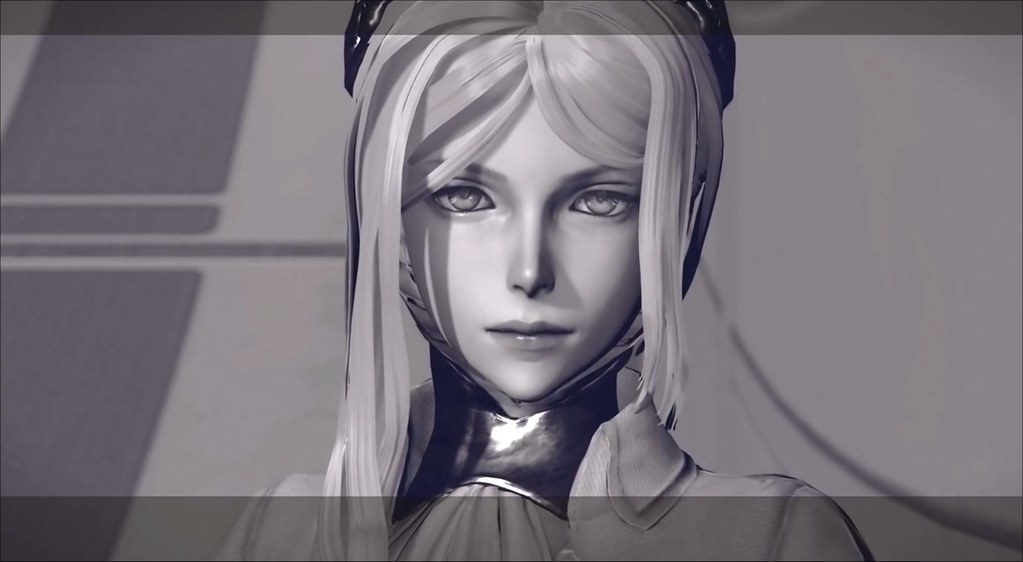
Does this unit have a soul? Can you offer me proof of your existence? War, what is it good for?
We've heard it all before, and NieR: Automata does nothing new to justify hearing it again. Even if you ignore the more explicit plot and focus on the subtext, just the last couple of years have seen a slew of games that made brilliant use of meta-plot and fourth-wall breaks, like Undertale, Pony Island and IMSCARED. Automata doesn't so much build on their insights as it makes poor copies of them, which I guess is at least thematically consistent with the poor copies its machines have made of human societies and customs.
That's what brings us to the one theme that Automata gets absolutely right: empathy. Because, after all, as the game asks explicitly at one point: why would these machines try to copy humanity so much even though in-game history shows it to have been a failure?
Part of the answer lies in the best part of the game's plot, the main story quest The Machine Surge. Upon reaching the surface and contacting the Android resistance, protagonists 2B and 9S are ordered to commit what is in practice an act of genocide by destroying all the machines in the desert. The machines fight back, which 9S uses as a rationale to keep attacking them:
"If they wanted help, why would they be attacking us?"
(Heard that one before!)
The machines then attempt to evoke empathy by voicing their feelings of fear and pain. When that fails, they flee, scrambling for a possible way to appease their attackers. They try anything from appealing to their conscience:
"You. Not. People."
To idle chat:
"Nice. Weather. Today."
When all this fails, the machines realize that they cannot defeat the Androids, nor convince to halt their attack, nor escape:
"This cannot continue!"
And so, they fuse together to give birth to Adam - a machine's idea of what a human looks like, based on the closest living example they've ever witnessed, namely, the Androids.
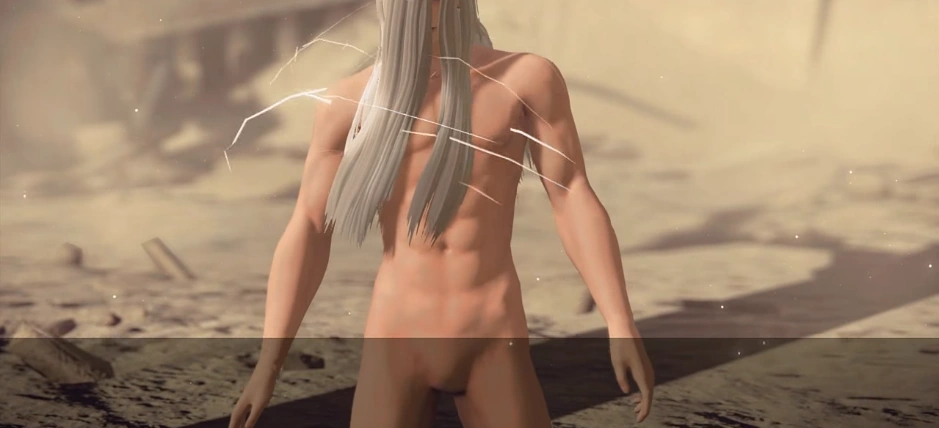
It may seem like Adam was created as a weapon. He certainly has strong offensive capabilities. But . rather than attack, the first thing he does is ask you why you are attacking him:
"An... droids... why... fight?"
His next step is to learn how to handle your aggression:
"Sword... dodge... projectile... deflect..."
(My god, the writing in this game)
And only then does he attack.
And then Eve climbs out of his chest, because Bible reference, get it?
Adam eventually becomes hate incarnate, believing that the essence of humanity is conflict. But this isn't a perspective that's hard-wired into him. It's a result of the fact that the sum total of his experience with anything approaching a human is getting cut, shot and stabbed by 2B and 9S, and his resulting beliefs are later affirmed by a biased reading of human history.
The machines didn't make Adam to be a weapon - they made him because they thought that if the Androids saw someone more like them, they would be less inclined to attack. It's the next logical step after the orchestrated charade of family life that we witness when the protagonists first step down into the sand pit where Adam is eventually created: the machines already know that YoRHa is coming and will not yield, and in their despair, hope that if they're easier for the Androids to identify with, they might be spared.
The machines didn't make Adam to be a weapon - they made him because they thought that if the Androids saw someone more like them, they would be less inclined to attack. It's the next logical step after the orchestrated charade of family life that we witness when the protagonists first step down into the sand pit where Adam is eventually created: the machines already know that YoRHa is coming and will not yield, and in their despair, hope that if they're easier for the Androids to identify with, they might be spared.
But that never happens. Years of indoctrination have made 2B and 9S completely incapable of empathizing with the machines, an intentional ironic contradiction to YoRHa's glorification of humanity. The whole scenario is a brilliant commentary on the role empathy plays in our lives and how it is upended by prejudice and incitement.
It's also a perfect illustration of just how badly NieR: Automata's story fails as a video game plot.
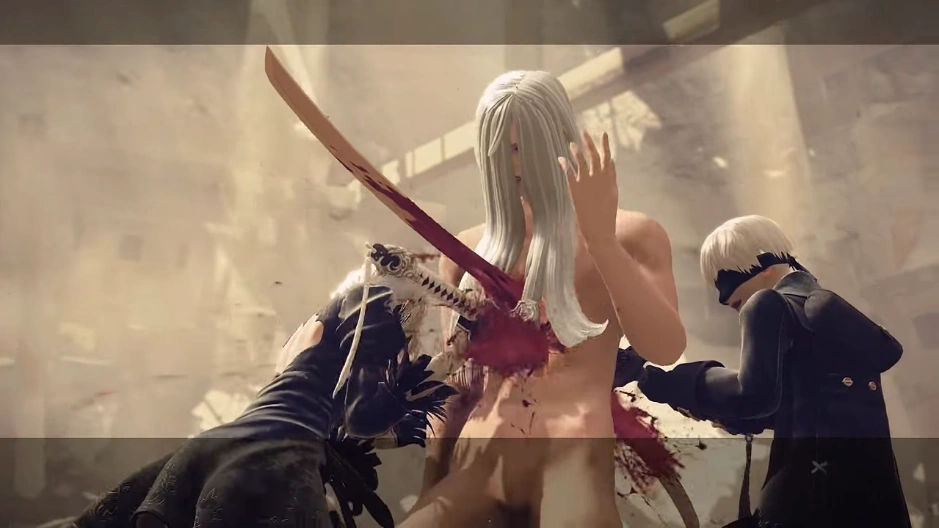
You see, as 2B and 9S were massacring the desert machines, I could tell the game wanted me to feel the Androids' inner conflict between their sense of duty and the undeniable fact that these machines were saying and doing things that are uncharacteristic for unthinking murder bots. But all I could think was: why am I playing this game? I don't want to murder these machines that are begging for their lives. I wouldn't do it in real life, no matter how badly I was incited against someone, and I know this because I was faced with similar choices in the past. NieR: Automata told me all about why YoRHa wanted these machines dead, but at no point did it explain why I should want to aid them.
There's a very important difference between character motivation in a movie or TV series and that of a character in a game: in both cases, there may be instances where someone has to play a character with whose motivation they don't identify. Actors who play villains generally don't want to nuke New York City or decapitate Gwyneth Paltrow - we hope - but they understand that their portrayal is vital to make the movie work. J. K. Simmons probably wouldn't be too thrilled about his role as Schillinger if the point of Oz was that being a Neo-Nazi is great. It's for the benefit of the story, and that's all the motivation an actor needs.
Also, I hear the money's pretty good.
In video games, players play a role, but they do so for their own benefit. Unless you're a YouTuber - in which case you should be ashamed of yourself anyway - chances are you're not playing a game thinking "wow, this would be really great for someone else to watch". You're doing it for your own benefit.
That doesn't mean, as some people claim, that games have to always be fun or entertaining. I'd be hard pressed to say I found 1979 Revolution: Black Friday or Detention fun, as much as I loved them. Nor is it necessary for a game to have a protagonist you could identify with: Yakuza 0, my favorite game this year so far, has you play as a couple of thugs who, personable as they might be at times, would do anything for money and power. But, to paraphrase Jim Sterling, you can't sell something on the lack of content. If a game isn't entertaining, and if you don't identify with its protagonist, there has to be some other reason for you to want to play, to enable the main characters' behavior.

Let's take a look at another critically-acclaimed game, to the point of utter hyperbole: The Last of Us. To keep spoilers at a minimum, the last part of the game faces you with an unambiguous fact: in order to cure humanity from the Cordyceps infection, a certain character, let's call them Character A, must be sacrificed. Character A agrees to sacrifice their life, and while this is a painful sacrifice, everyone understands it must be made - everyone except the character you play at that point, let's call them Character B. Unwilling to accept this sacrifice, Character B goes on a rampage, slaughtering many people who only have humanity's best interest in mind to save Character A.
It's a great character moment, but it's handled extremely poorly as game plot. No matter how closely you identify with either character, and no matter how many of us would do the same in that situation, there's no way you could justify these actions - and if you can, you should probably check yourself. What possible motivation could a player have to go through with this maniacal, selfish, murderous plan except to get to see the ending credits?
NieR: Automata has the benefit of being a much better game than The Last of Us, inferior voice-acting notwithstanding. But when it comes right down to it, it fails in the same way.
I expect to have a video covering these points, and maybe a few others, in the next few weeks. Chapter Select notwithstanding, getting all the footage I need this time might take a while. But I think it's a really important and under-explored aspect of the way we tell stories in games.
For now, here are a couple of links to articles that I've dug up during some preparatory research:
Pixel Scribe on Player-Character Dissonance in Dragon Age: Inquisition
The Astronauts on Empathy and Game Design
 I really liked Uncharted 4, probably for the same reasons that longtime fans of the series apparently did not. It focuses less on wanton murder and more on making likable characters, establishing the relationships between them, and basing climbing sections less on trial-and-error nonsense and more on getting a feel for how the game's environment functions.
That's why I'm kinda disappointed at Neil Druckmann's response to a question in a Rolling Stone interview about the violence, or rather, the "ludonarrative dissonance" in the Uncharted games:
"...we don't buy into it. I've been trying to dissect it. Why is it that Uncharted triggers this argument, when Indiana Jones doesn't? Is it the number? It can't be just the number, because Indiana Jones kills more people than a normal person does. A normal person kills zero people. And Indiana Jones kills a dozen, at least, over the course of several movies. What about Star Wars? Han Solo and Luke Skywalker, are they some sort of serial killers? They laugh off having killed some stormtroopers. And in The Force Awakens, we see that a stormtrooper can actually repent for the person he is and come around, and there are actually real people under those helmets."
The only examples Druckmann can think of to justify Nathan Drake killing dozens of people to get some treasure are movies where protagonists kill either actual Nazis are very transparent metaphors for them. Nathan Drake isn't killing fascist soldiers to save humanity from fascism; he's killing mercenaries and guards to dig up treasure, a task at which he constantly seems to fail.
Again, this is a case where the character has a much clearer motivation than the people playing the game. It's very indicative of this problem in game writing that the really difficult questions about violence, as well as block-pushing puzzles, came from a publication that traditionally doesn't focus too much attention on video games.
The Astronauts on Empathy and Game Design

That's why I'm kinda disappointed at Neil Druckmann's response to a question in a Rolling Stone interview about the violence, or rather, the "ludonarrative dissonance" in the Uncharted games:
"...we don't buy into it. I've been trying to dissect it. Why is it that Uncharted triggers this argument, when Indiana Jones doesn't? Is it the number? It can't be just the number, because Indiana Jones kills more people than a normal person does. A normal person kills zero people. And Indiana Jones kills a dozen, at least, over the course of several movies. What about Star Wars? Han Solo and Luke Skywalker, are they some sort of serial killers? They laugh off having killed some stormtroopers. And in The Force Awakens, we see that a stormtrooper can actually repent for the person he is and come around, and there are actually real people under those helmets."
The only examples Druckmann can think of to justify Nathan Drake killing dozens of people to get some treasure are movies where protagonists kill either actual Nazis are very transparent metaphors for them. Nathan Drake isn't killing fascist soldiers to save humanity from fascism; he's killing mercenaries and guards to dig up treasure, a task at which he constantly seems to fail.
Again, this is a case where the character has a much clearer motivation than the people playing the game. It's very indicative of this problem in game writing that the really difficult questions about violence, as well as block-pushing puzzles, came from a publication that traditionally doesn't focus too much attention on video games.
March 14, 2017
How to Not Prove that Pi = 4
Today is March 14, which, due to 3.14 being the most common approximation for the most well-known mathematical constant, is celebrated as Pi Day. Some mathematicians frown upon that, since they know that Pi isn't actually equal to 3.14 and think that impresses someone, but any excuse to write about math is fine by me.
So before we get into anything else, we need to ask - what is Pi? A lot of people know that it's the ratio between the circumference and the diameter of a circle, but who's to say that ratio is the same for all circles? You can measure some circles and see that the ratio is pretty much the same, but who says that it's exactly the same? Who says we didn't just get lucky and pick a few circles that happen to have that ratio?
In other words, we want to prove that Pi is well-defined - that the definition we gave of Pi as said ratio actually means something.
Well, there's good news and bad news on that front. The good news is that there's a basic, intuitive proof that doesn't require a whole lot of mathematical background to understand. The idea is as follows:

So before we get into anything else, we need to ask - what is Pi? A lot of people know that it's the ratio between the circumference and the diameter of a circle, but who's to say that ratio is the same for all circles? You can measure some circles and see that the ratio is pretty much the same, but who says that it's exactly the same? Who says we didn't just get lucky and pick a few circles that happen to have that ratio?
In other words, we want to prove that Pi is well-defined - that the definition we gave of Pi as said ratio actually means something.
Well, there's good news and bad news on that front. The good news is that there's a basic, intuitive proof that doesn't require a whole lot of mathematical background to understand. The idea is as follows:

Image shamelessly pilfered from ProofWiki
- Position two circle so that they're centered at the same point, and in particular, the one with the smaller radius lies inside the one with the larger radius.
- Choose some integer, n, which is equal to at least 3, and divide both circles to n equal parts, like slices of pizza, i.e. by drawing straight lines from the center to the perimeter of the outer circle.
- Now, for each circle, connect each points where the straight lines from step 2 intersect it with its neighbor.
- We now have two families of triangles, one for each circle. The sides of each triangle are the length of the corresponding circle's radius, and the angle between the sides is the same for all triangles - namely, it is equal to 360 degrees divided by n, the number of triangles we divided our circles into.
- In particular, each small triangle is contained in a large triangle such that the ratio of the sides is the ratio of the smaller radius to the larger radius, and the angle between these sides is equal. Laws of triangle similarity dictate that the ratio of the "bases" - the third edge formed by connecting two points on the perimeter of the circle - is also the ratio of the smaller radius to the larger radius.
- Now the magic comes in: as you can clearly see from the image up there, the larger n is, the more the sum of the bases of the triangles approach the circumference of the circle they're contained in. But we've seen that the bases of the triangles have the same length ratio as the radii, and since this is true for every n, in particular, the ratio of circumferences thus approximated must also be the ratio of the radii.
- Step 6 shows us that, if we mark the circumference of the smaller circle by $P_1$ and its radius by $R_1$, and do the same with index 2 for the larger circle, we have $$\frac{P_1}{P_2}=\frac{R_1}{R_2}$$ which is the same as saying $$\frac{P_1}{2R_1}=\frac{P_2}{2R_2}$$ thus showing that, indeed, the ratio between circumference and diameter is constant.
Those were the good news. The bad news is that, alas, our approach can be used to render all of mathematics meaningless, for as the follow image shows, it can be used to prove that Pi is not roughly 3.14 but is, in fact, 4:

Which is a shame. I liked math. It's too bad that it has to Go Away Forever.
Well, as you can guess, the problem isn't so much with math as with our reasoning. Like I said, our approach can be used to show that Pi equals 4, but that just shows that our approach is wrong. Specifically, the issue lies in step 6, where we said that the lines formed by the bases of our triangles approach the perimeters of the circles and that therefore their lengths must also be the same. This reasoning is dead wrong, even if our conclusion was correct. Actually, math is full of examples of correct results one can reach with bad reasoning - my favorite is $$\require{cancel} \frac{64}{16}=\frac{\bcancel{6}4}{1\bcancel{6}}=4$$ Don't get me wrong - the approach of calculating a curve's length by approximating its length with a sum of lengths of straight lines that becomes ever-closer can be used correctly. In fact, it's pretty much what we're going to do. But as we can see, sometimes it works, and sometimes it doesn't, and to understand when it can actually work, we need to be a bit more rigorous. In fact, this is probably the simplest example I know of showing just how important mathematical rigor is.
So how do we show that Pi is well-defined? For this, just like with all good things in life, we're going to use Calculus - specifically, line integrals. The theory of integration is more than I can cover in a single blog post, but the idea is the same - calculate areas, lengths of curves or anything else by making these calculations for more basic shapes, and show that these basic shapes can be used to approximate the complex ones. The key is in the last step, though - understanding which approximations work and which don't, and most importantly, why. If I've made that point in this post, then my work here is done.
Just to be cool, though, let's show our calculus proof in full. We will calculate the length of half the perimeter of a circle with radius $R$ using the following parameterization: $$x(t) = t, y(t) = \sqrt{R^2-t^2}, -R \le t \le R$$ Why not use the more standard parametrization using cosine and sine? I'll leave that for you to answer, but think about how you would go about justifying each step of the following calculation using that parametrization.
Onwards, then. Let's use $P$ to denote the circumference of the circle. The integral we must now calculate is $$\int _{-R} ^{R} \sqrt{x'(t)^2+y'(t)^2}dt$$ which, after some calculations, is shown to be $$R \cdot \int _{-R} ^{R} \frac{1}{\sqrt{R^2-t^2}}dt$$ Now here comes the real magic. In this integral, substitute $v = \frac{t}{R}$. This gives us the integral $$R \cdot \int _{-1} ^{1} \frac{1}{\sqrt{1-v^2}}dv$$ But with $P$ as above, we have $$\frac{P}{2}=R \cdot \int _{-1} ^{1} \frac{1}{\sqrt{1-v^2}}dv$$ or equivalently $$\frac{P}{2R}= \int _{-1} ^{1} \frac{1}{\sqrt{1-v^2}}dv$$ Now check out this beauty! On the left hand side we have our coveted ratio, but on the right we have a definite integral - a number - which more importantly than anything else, does not depend on $R$, It's also kinda important that the function we're integrating is continuous and bounded over the closed interval of integration, which means that our integral exists.
Some of you may be tempted to say the primitive function here is $arcsin(v)$ and conclude that the left-hand side is indeed equal to $\pi$. But that would be naughty, as we have only now shown that Pi is well-defined, and that makes any reasoning in that direction fishy. But the important part is that the right-hand side is a constant, and from here, all the wonders of geometry, trigonometry and much of calculus are ours for the taking.

Which is a shame. I liked math. It's too bad that it has to Go Away Forever.
Well, as you can guess, the problem isn't so much with math as with our reasoning. Like I said, our approach can be used to show that Pi equals 4, but that just shows that our approach is wrong. Specifically, the issue lies in step 6, where we said that the lines formed by the bases of our triangles approach the perimeters of the circles and that therefore their lengths must also be the same. This reasoning is dead wrong, even if our conclusion was correct. Actually, math is full of examples of correct results one can reach with bad reasoning - my favorite is $$\require{cancel} \frac{64}{16}=\frac{\bcancel{6}4}{1\bcancel{6}}=4$$ Don't get me wrong - the approach of calculating a curve's length by approximating its length with a sum of lengths of straight lines that becomes ever-closer can be used correctly. In fact, it's pretty much what we're going to do. But as we can see, sometimes it works, and sometimes it doesn't, and to understand when it can actually work, we need to be a bit more rigorous. In fact, this is probably the simplest example I know of showing just how important mathematical rigor is.
So how do we show that Pi is well-defined? For this, just like with all good things in life, we're going to use Calculus - specifically, line integrals. The theory of integration is more than I can cover in a single blog post, but the idea is the same - calculate areas, lengths of curves or anything else by making these calculations for more basic shapes, and show that these basic shapes can be used to approximate the complex ones. The key is in the last step, though - understanding which approximations work and which don't, and most importantly, why. If I've made that point in this post, then my work here is done.
Just to be cool, though, let's show our calculus proof in full. We will calculate the length of half the perimeter of a circle with radius $R$ using the following parameterization: $$x(t) = t, y(t) = \sqrt{R^2-t^2}, -R \le t \le R$$ Why not use the more standard parametrization using cosine and sine? I'll leave that for you to answer, but think about how you would go about justifying each step of the following calculation using that parametrization.
Onwards, then. Let's use $P$ to denote the circumference of the circle. The integral we must now calculate is $$\int _{-R} ^{R} \sqrt{x'(t)^2+y'(t)^2}dt$$ which, after some calculations, is shown to be $$R \cdot \int _{-R} ^{R} \frac{1}{\sqrt{R^2-t^2}}dt$$ Now here comes the real magic. In this integral, substitute $v = \frac{t}{R}$. This gives us the integral $$R \cdot \int _{-1} ^{1} \frac{1}{\sqrt{1-v^2}}dv$$ But with $P$ as above, we have $$\frac{P}{2}=R \cdot \int _{-1} ^{1} \frac{1}{\sqrt{1-v^2}}dv$$ or equivalently $$\frac{P}{2R}= \int _{-1} ^{1} \frac{1}{\sqrt{1-v^2}}dv$$ Now check out this beauty! On the left hand side we have our coveted ratio, but on the right we have a definite integral - a number - which more importantly than anything else, does not depend on $R$, It's also kinda important that the function we're integrating is continuous and bounded over the closed interval of integration, which means that our integral exists.
Some of you may be tempted to say the primitive function here is $arcsin(v)$ and conclude that the left-hand side is indeed equal to $\pi$. But that would be naughty, as we have only now shown that Pi is well-defined, and that makes any reasoning in that direction fishy. But the important part is that the right-hand side is a constant, and from here, all the wonders of geometry, trigonometry and much of calculus are ours for the taking.
January 20, 2017
New Song - Terra's Theme (Final Fantasy VI cover)
Final Fantasy VI is widely claimed to be the best game in the series, even though everyone knows it's third after VII and IV. But all the same, it's a fantastic game, that to my great shame, I never actually beat. I got to that part - you know the one I mean if you played the game - and wanted to do everything you're supposed to do at that point, but real life intervened and it just fell by the wayside. I'm working on a full playthrough as we speak, I promise!
VI isn't just a fantastic game but, like every game scored by Nobuo Uematsu, has an amazing soundtrack. Terra's Theme in particular has always stood out to me as one of the most beautiful songs I've ever heard, and I've been playing a half-baked acoustic version of it I've improvised one day on and off for years now. Since I've been having some technical issues preventing me from working on full-blown electric releases, this felt like a great way to keep working on music while also paying tribute to a game and a soundtrack beloved by myself and many others. I've worked on it for quite a bit, and I ended up very happy with the arrangement I gave it. Hope you feel the same way!
Of course, as always, I would appreciate it if you spread the word.
VI isn't just a fantastic game but, like every game scored by Nobuo Uematsu, has an amazing soundtrack. Terra's Theme in particular has always stood out to me as one of the most beautiful songs I've ever heard, and I've been playing a half-baked acoustic version of it I've improvised one day on and off for years now. Since I've been having some technical issues preventing me from working on full-blown electric releases, this felt like a great way to keep working on music while also paying tribute to a game and a soundtrack beloved by myself and many others. I've worked on it for quite a bit, and I ended up very happy with the arrangement I gave it. Hope you feel the same way!
Of course, as always, I would appreciate it if you spread the word.
December 31, 2016
The Psycho Mantis Video Game Awards 2016
Keeping that Glass Half-Full With Video Games

Honestly, I'm already sick of people saying 2016 was a terrible year, but my god was 2016 a terrible year. Disasters seemed to keep piling on in both the personal and political realms. Artistic icons passed away, revolutions were drowned in blood, and tragedies just kept piling on for me and the people I care most about.
It's with some bitter irony, then, that I note just how amazing this year was for video games. I thought 2015 was good, but man if 2016 didn't blow it out of the water. Whether indie or AAA, action or story driven, PC or console, game developers put out some of their best work this year.
Of course, none of this makes up for the terrible things that happened. No amount of amazing video games is worth one Aleppo. But if there's anything to take from this year, it's the power of art and entertainment to help people deal with the hardest of times, and I hope this post shows that video games are continuing to prove their place as the foremost medium in both fields.
Now we just need to get rid of all of that human misery and make sure that everyone can enjoy them.

Of course, the same is true for any other game with similar business practices. This is an issue that may have Mankind Divided, but I have no doubt where I stand.
Genji.
For the Record: No Fee-To-Pay

You Mei notice that one game that can be found in many, many GOTY lists is missing here. It's a game that has been a Bastion of enjoyment for me, having played it for around 300 hours now, and I doubt I'll stop anytime soon. When I played its open beta, I couldn't wait to get my Hanzo on it, and I've been enjoying its biZarya charms ever since it hit the Roadhog.
It's also a full priced game that had the gall to include microtransactions, and what's more, only allowing you to buy random lootboxes that are mostly filled with Junkrat. It's a real Reaper-off, and although it's not a pay-to-Winston system, it's scummy all the same.
This year we are faced with the Sombra realization that ever more scummy business practices are finding their way into the premium games market. It's a fact that has affected me on both a personal and professional level. You may find it Anal, or argue that I'm going too Pharah. Still, as Reinhardt as it is, and as much as I'm Torbjörn about this decision, I can't just be Zenyatta and let it go. This is how industries Widow and die. And so, I cannot consider this game - at whose identitiy I will only very, very subtly hint - for GOTY.
Some will say this is hypocritical, since other games with DLC and season passes are featured here. However, there's no Symmetra between games with significant, well-defined expansions and those with endless, random microtransactions.
I am under no IlLucion that this will change anything in the near future, and I know it makes me look like a bit of a D.Va, but I believe everyone needs to follow their McCreed, and so, there can be no Mercy in the matter.
Some will say this is hypocritical, since other games with DLC and season passes are featured here. However, there's no Symmetra between games with significant, well-defined expansions and those with endless, random microtransactions.
I am under no IlLucion that this will change anything in the near future, and I know it makes me look like a bit of a D.Va, but I believe everyone needs to follow their McCreed, and so, there can be no Mercy in the matter.
Of course, the same is true for any other game with similar business practices. This is an issue that may have Mankind Divided, but I have no doubt where I stand.
Genji.
The Psycho Mantis "Reckless Person" Award For Worst Video Game, 2016
About a month ago, Steam Spy revealed that almost 40% of all Steam games came out this year. With the platform increasingly filled with utter garbage made by people who could only jokingly be referred to as "developers", it might seem questionable that any game with a decent budget or effort put into it could be the worst game released this year. However, reception is always relative to expectation, and there is very little to be gained from critiquing Steam's dumpster fires.
With that in mind, the worst video games released in 2016 are...
With that in mind, the worst video games released in 2016 are...
Street Fighter V

And so, when SFV came out, my good judgement and apprehension towards AAA gaming went out the window, and I ended up getting it on launch day. Imagine my surprise when I found out the game's story mode consisted of three incredibly easy fights for each character, and that it took upwards of 6 minutes to find a game online. Since launch, an extended story mode came out, but it's as boring as the original, and while online matches don't take quite as long to find, it's still well beyond what should be acceptable for a fighting game.
Laughably touted as a Street Fighter for fighting game pros, Street Fighter V is barren and dim-witted, a stain on what is still my favorite fighting game franchise.
Shadwen

On paper, Shadwen sounds great. It's a stealth game where, just like in SUPERHOT, time only moves when you do (although in Shadwen, time completely stops instead of just passing very slowly), set in a world that looks and feels a lot like that of the first Witcher game.
Sadly, all Shadwen does is prove once more that good ideas don't mean much on their own. The game constantly crashes, platforming (which this game has for some reason) is awkward and finicky, and the guards are practically blind, making stealth trivial and dissatisfying.
Despite my best efforts, the game broke me pretty early on, when I was presented with a choice on whether to kill a guard or sneak past him. Or I would be, if a bug didn't force me to take a lethal approach either way. Even when, digging through the game's Steam forums, I found an exploit that allowed me to sneak by, I was still accused in the following cutscene of killing the guard. When a game gives you a choice and then ignores completely the one you took, what's the point?
I still say Shadwen's concept has a lot of promise. Here's hoping someone manages to capitalize on it in the future.
République


Bombshell

Sadly, no. If you think Bombshell can give you over-the-top action-movie stupidity, you're in for a disappointment. If anything, Bombshell is weirdly understated, with a distinct lack of audio-visual feedback that makes all the shooting and explosions feel empty and complete lacking in impact. One turret section - because apparently the year is 2009 - was so quiet that I started wondering if I'm being pranked.
When it's not trying to kill by being dull in look and feel, Bombshell tries to torture you with its humor. A cursory look at anything I've ever written will make it very clear that I have an idiot's sense of humor, and even I found Bombshell's jokes to be assaults on the very idea of humor. There actually a weapon in this game called a Maxigun - get it? Because Bombshell is a woman? For fuck's sake.
Back In 1995

Almost forgot about this one, and I haven o idea how I could! The glitches, the awful writing, the poo monsters - everything about Back In 1995 screams style over substance, trying to capture in painstaking detail the looks and controls of old survival horror games - up to and including an option to turn on CRT effect, no thank you - with no understanding of what made them great. As I wrote about its conscious attitude to some of its mechanics as "gimmicks" at the time,
"...that could be said about practically anything in Back In 1995: it's all a gimmick. Resident Evil had turret controls because the first PlayStation didn't have dual analog sticks. Silent Hill had fog because the PlayStation wasn't powerful enough to render the large environments Team Silent wanted to use. Why does Back In 1995 do anything that it does? Just because. Just to make you think of the old horror games you liked, in the hopes that maybe you'd like it by-proxy."
I didn't, and that seems to be general consensus. With a new Resident Evil touted as a return to the series' survival-horror roots and at least one Silent Hill-throwback game planned for release in 2017, let's hope the future is a bit kinder to classic survival horror.
Worst of the Year - Knee Deep + Virginia


There are game developers who borrow heavily from film, using cinematic techniques to enhance their writing and visuals. Then there are developers who prefer to tell stories in a way that is more uniquely available to video games, including especially the metagame narratives we've seen more and more of following the success of Undertale and Pony Island. These two trends in video-game storytelling both have their merits, and the differences and interplay between them deserve a more thorough analysis than they have been given so far.
One category of games that get entirely too much attention, though, is that of games that try very hard to convince that they are something else. The foremost representatives of this category I've come across this year are Knee Deep and Virginia, the former trying to present itself as a play, the latter as a movie. Lucky for them, they are, in fact, video games; otherwise, they would be shred to pieces by any self-respecting critic in the media they try to ape.


Knee Deep has you play a reporter, and the interactivity reduces to the way you decide to write your stories. You can be "Cautious", "Edgy", or "Inflammatory", but no matter what you choose, the result will be some cringe-worthy blocks of text or dialogue. Theater prides itself on wit and depth, two qualities sorely missing from Knee Deep.
Virginia is so overflowing with pretentiousness that it actually replaces the Play Game option from the main menu with Play Feature. It is so desperate to be like a movie that it recommends that you play at 30 frames per second, as if that's going to make its terrible character models or barren environments look any better. It still gives you an aiming reticle, though, because video games.
The problem with Knee Deep and Virginia isn't in technical aptitude, although there's some real uncanny-valley stuff going on in both games. The problem is their basic design philosophy, which seems to argue that in order for video games to grow as a medium, they need to become something else. They represent a sinister trend in game design, with a massive cognitive dissonance between the way they view themselves and what they end up achieving.
Fortunately, I believe these to be the death pangs of that trend. It's been a while since anyone went looking for gaming's Citizen Kane, and hopefully, in the future, games like Knee Deep and Virginia will be dealt with the sort of bemused scorn they deserve. We have too many good developments in video games for them to get anything else.
Also, what's with the way they drew hands in Virginia?


Jesus Christ.
Also, what's with the way they drew hands in Virginia?


Well, that's the crap out of the way. On to the good stuff!
The Psycho Mantis "Prudent Person" Award For Best Video Game, 2016
Honorable Mention - Downwell

Although a 2015 game technically, Downwell got its Android and PS3/4/Vita versions this year, allowing me to sink unthinkable amounts of time into it on various platforms. If you still haven't tried this one, I urge you to do so now. It really is one of the finest platformers ever made, brilliantly designed, beautiful and most importantly, incredibly fun.
Honorable Mention - Slain: Back From Hell

Slain is a game I was really excited for when trailers first came out. A retro, heavy-metal swords-and-sorcery platformer sounds right up my alley. When it came out, however, it got a very cold reception due to a very basic combat system, a lot of missing audio cues, and an all-around shoddy presentation and feel. Disappointed, I decided to forget about the game.
Luckily, Slain fell into the hands of a much better team, and Slain: Back From Hell was released as an apology to those who were so disappointed in the end product. The result is a game that, while not revolutionary in any way, is a whole bunch of fun and, by all accounts, is far better than the original.
It's bad practice to give awards to games that patched out problems after release, which is why Back From Hell shouldn't be considered for GOTY. However, it gets a mention because it is a positive counter to that commonly misused Shigeru Miyamoto quote about delayed games: here we have a game that was bad, but won't be bad forever. Here's hoping the people who got it that way will get to make a new game from the ground up. Whether it'll be a Slain 2 or an entirely new game, they certainly deserve credit for the respect they have shown their audience and the medium.
Also, the dialogues between the protagonist and the crone are amazing.
Also, the dialogues between the protagonist and the crone are amazing.
Firewatch

Firewatch has the distinction of being the first walking simulator I truly enjoyed. To this day, when I think about it, I remember its lovely art style, the quiet ambience of the wind and water, the animals you see along the way, and how good it feels to just move around the world and take in its beauty. While some of its trickery is apparent and jarring - like when two distant characters are represented by stick figures and the game thought we wouldn't notice - it just works so well most of the time that these issues are easy to forgive.
I only played Firewatch once so far, which is unfortunate. This is one walking simulator where your choices actually have an effect on the story, and the developers even included dialogue for a set of choices few players are likely to take up, where you simply ignore dialogue options altogether. The silent exploration leaves so much space for you to think about what's going on and what you want to say and do next, and it never feels like you're railroaded into treating characters a specific way just because the game wants you to. Plus I liked the ending, so there.
Oh, and you can play with turtles!
Many turtles.
I only ever found one, though.
DarkMaus

I wasn't massively impressed by Dark Souls III. In general, I find the Dark Souls games are the least enjoyable of the Soulsborne games, and while III is probably the best of the trilogy, it doesn't even approach the level of quality of Bloodborne. I also didn't like how it referenced the first game - to me, a lot of the fun of playing From's games is in trying to make sense of the alien world I have been put into, and when I know so much of the world already, that sense is completely gone. And so, sadly, Dark Souls III isn't one of my favorite games of the year, but thanks to DarkMaus, it's not even my favorite Souls-like game of the year.
DarkMaus' premise is simple: a top-down adventure game with a Dark Souls-style combat system where you play a mouse. However, the devil is in the details here, and what DarkMaus truly succeeds in is in creating the sort of bleak world atmosphere that is integral to the series that it's aping. There's secret areas, madness, brutality, cruelty, betrayal - all the arcane mystery and danger that make these games stick with players so much.
And it even has a dodge system that isn't a broken mess, so that's nice.
Uncharted 4
This one was not expected. I hated Uncharted 3, and am one of the few people on the planet who found The Last of Us very meh, because I'm not a sucker for hype I just didn't think it was mechanically all that interesting.
However, Uncharted 4 is legit. It's a loud, dumb action game, but it has real soul to it. It is finally a Naughty Dog game with interesting characters and an actual point to make, a story about siblings - which I'm always a sucker for - and the way they balance their desire to make each other happy with their own happiness. And while I didn't much care for the actual shoot-outs, I really liked the platforming sections, which is surprising because that's hands-down what I hated the most about 3. I also think the multiplayer must've been pretty good in those first few weeks before it completely died.
Uncharted 4 is so good that it's pretty high on my list of games from this year I want to replay. Naughty Dog finally made a game I love, and I couldn't be happier.
However, Uncharted 4 is legit. It's a loud, dumb action game, but it has real soul to it. It is finally a Naughty Dog game with interesting characters and an actual point to make, a story about siblings - which I'm always a sucker for - and the way they balance their desire to make each other happy with their own happiness. And while I didn't much care for the actual shoot-outs, I really liked the platforming sections, which is surprising because that's hands-down what I hated the most about 3. I also think the multiplayer must've been pretty good in those first few weeks before it completely died.
Uncharted 4 is so good that it's pretty high on my list of games from this year I want to replay. Naughty Dog finally made a game I love, and I couldn't be happier.
Oxenfree

5 minutes in, I was gearing up to hate Oxenfree, with its typical cast of obnoxious douchebag teenagers you're supposed to want to see dead. Not too long afterwards, though, Oxenfree got its hooks in me. The characters became more interesting, the atmosphere got truly dark, and I got more and more interested in uncovering the story beyond the funny radio noises.
Horror is at its best when it is accentuated by silliness, and Oxenfree uses this in its favor with great proficiency. Humor is used to great effect, endearing characters to you and making the moments where you have to make tough decisions about them all the more effective. If you were turned off by the first few scenes of the game, I urge you to reconsider - there's depth to this game, even if it comes off as initally as typical horror schlock.
IMSCARED

2016 saw a whole bunch of games released whose point was to completely shatter the fouth wall, to the point where this risked becoming an annoyingly-overused concept for a while. Pony Island, Calendula and SUPERHOT all had uncooperative menu screens and creepy texts trying to get in your head.
However, to me, IMSCARED stands above all those other games in successfully playing on the player's fears, to the point where I actually don't want to say any more about it. Just go play it. It's dirt cheap, scary as hell, and amazing. It got to me on a basic, almost technical level, but I can't say more without ruining something so just Go. Get. It.
Kathy Rain

Grant us eyes, grant us eyes!
Kathy Rain's Android version was released on a week when I was suffering some serious leg pain, to the point where I had to stay in bed. Good thing, too, because once I picked it up, I couldn't stop.
Kathy Rain is a retro point-and-click game, of the kind that has been having a bit of a renaissance lately, no doubt due in part to Jay Tholen's excellent Dropsy. Rain is a college student and a budding detective who one day finds out that her long-estranged grandfather has died. After his funeral, she reconnects with her grandmother and starts to investigate the mysterious circumstances of his death.
Point-and-click puzzle games are notorious for their obtuse, moon-logic puzzles, which is why I was so pleasantly surprised by Kathy Rain. The puzzles are challenging, but upon finding out the solution, you never feel like you lucked out or just combined items until something worked. Despite there being a bit too much going back and forth between places to my taste, it always feels like there's a logic to the solutions, even when it isn't necessarily apparent. The result is that the process of coming up with a solution is so enjoyable that you're never frustrated by being stuck, something very few puzzle games manage to accomplish.
Aside from solving puzzles to progress through the story, Kathy Rain also gives the player the chance to connect the dots between the many plot threads in the game, exploring themes of corruption, insanity, abuse, friendship and family, among others. It's a beautifully crafted story, with many touching and funny moments, with an ending that's effective in a way that I unfortunately can't say more about without spoiling it. Suffice to say, it's one of the most satisfying stories I've seen in a while.
So I really hope that sequel baiting ending was legit, because I'd play the shit out of a Kathy Rain 2.
1979 Revolution: Black Friday

There's very little I can say about 1979 Revolution that I haven't already said in my review, but I believe this part sums things up quite well:
"Banalities are never in short supply when one tries to discuss the popular uprisings of the past: "revolutions devour their own children", "violence begets violence", "absolute power corrupts absolutely" - such platitudes are often all people feel the need to say about events that have had enough books written about them to fill up a library. When they take place in a Middle-Eastern country, the racist idea that Muslims, left to their own devices, can only replace a pro-Western dictatorial regime with an even worse, Islamic regime, is all the more tempting to those whose understanding of the region has been heavily colored by post-9/11 Islamophobia...
With such heavy subject matter to tackle, 1979 Revolution: Black Friday's triumph in interactive storytelling is all the more significant. By having the player character take an active role in the revolution as well as exposing players to its social, cultural and political backdrop, it can be said with no hyperbole that it has won an important place in video game history."
Unforutnately, I believe recent events make this statement all the more pertinent.
Best of the Year - DOOM

No surprises here. After years of grey military shooters, the king is back. DOOM manages to take the level design of the first Doom and the fast paced shooting galleries of the Doom II and mix them up into something that isn't exactly like either of those games, but instead a new, superior product. I've written about the brilliance of DOOM's mechanics, the way they complement each other and contribute to the game's sheer adrenaline rush of a pace; slightly better known gaming media people have spoken about the genius way it characterizes its protagonist; but what's truly amazing about DOOM is that none of that analysis is really that necessary.
Don't get me wrong, it's fun to analyze DOOM as much as any great game. But a lot of media becomes better or worse upon reflection. But DOOM's qualities are so obvious and distinctive that it seems so much easier to let it speak for itself. A lot of game design is concerned with having the player realize how to play the game without telling them explicitly how to do so, and in that sense, DOOM is a masterpiece of game design. It is by no means easy - on Nightmare difficulty, it's quite a challenge - but the difficulty always encourages adjustment rather than repetition.

DOOM could have easily been a very bleak game, constantly trying to shock players with the sheer horror and misery of hell. There is some of that in the game, of course; but it also knows how to be colorful, almost cartoony, respectful of its past without having any of what it does feel like gratuitous fan-service.
It's also such a beautiful game. I mean, look at this flower jar.


It's also such a beautiful game. I mean, look at this flower jar.

That flower jar...

THIS FUCKING FLOWER JAR, MAN

A lot of people complained about the multiplayer, but I actually like it quite a lot. I have put more time into certain team-based, objective-driven games that shall remain nameless, but as far as mindless run-around-shooting games, this is the sort of multiplayer mode I've always wanted. It's fast and tactical, the complete opposite of Call of Duty's hope-you-see-the-other-guy-first style, and most importantly, you can turn into a demon - including, after some recent updates, a Cacodemon.
You can be a Cacodemon, people.
How could this ever not by GOTY?
***
Well, that's it for 2016. It's December 31st, and it's time for my yearly tradition of playing Metal Gear Solid alone in my apartment and wondering why no one likes me SEE YA'LL NEXT YEAR!
Subscribe to:
Posts (Atom)